



Timber is a natural and user-friendly construction material that has proven its reliability throughout history. Our ancestors have been building timber houses for thousands of years; this means that the experience and traditions of our forefathers are at our disposal. By adding our modern tools and knowledge, we can build comfortable houses that meet all the modern requirements. Nordic pine with its finely spaced growth rings is a well-known and sought-after building material around the world and the timber felled in winter makes the best construction material. Therefore, if you plan to begin the construction of your house next spring, it would be advisable to start making arrangements for the construction drawings and the construction works this autumn at the latest. Changes and adjustments in the drawings can be made until the beginning of the manufacture; however, these must be added in writing to our contract. If you contract us in the autumn, we can harvest the timber at the best time for quality log house material.
1. Natural Round Log profile
2. Square log profile
3. D-shaped log profile
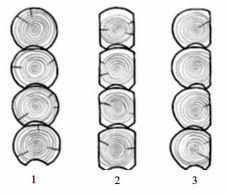
Natural Round Log is the most archaic profile which is also the most wholesome, weatherproof and heatproof one. Natural Round Log enables to relax the tension in the logs to help avoid checking which would significantly reduce the heatproofness of the house. However, there is a drawback − placing furniture along the walls is a bit more complicated. This problem can be fixed by hewing the interior walls. The house will retain its weatherproofness, the exterior wall will have less checking and the interior wall will be smooth and modern. A reverse option is also available − if you wish to add extra insulation to the exterior walls, it is possible to hew the exterior walls and leave logs in the interior of the house rounded and archaic.
For a house that is habitable all through the year, the diameter of the logs must be at least 250 mm. Saunas, summerhouses and ancillary buildings can be constructed from logs with a diameter of 180 mm.
Square logs originate from the time when it became fashionable to build houses in the country that resembled the ones in the cities so that they could be weatherboarded. Square logs are less heatproof, they also take twice as long and twice as much work to be manufactured because they need to be milled from both sides; this also increases the cost of the house.
A groove is a carving at the bottom side of the log which copies the shape of the log underneath it. Grooves are necessary for a tight fit of the logs and to heatproof the wall. Two different grooves are used: an equal scribe groove and an overscribed groove.
Overscribed logs are more windproof and heatproof because the logs that are stacked on top of each other have thinner groove edges and the extra space in the groove is chinked with insulation materials. The house will compress the logs together with its own weight and this makes the log walls windproof. The best thermal insulation is provided by the so called U-shaped overscribed groove. The chinking remains invisible in the case of the overscribed groove; any material that sticks out from the groove is trimmed. Overscribed grooves help to make the walls structurally stronger and are therefore a better option for higher buildings.
An equal scribe groove is the more traditional approach; the groove fits the curve of the log below exactly, the sides of the groove remain open. This allows you to add chinking after the entire wall has been stacked. You can also add extra insulation after a couple of years when the logs have taken their final shape after twisting and shrinking. However, the chinking that you have tucked between the logs will remain visible. Using equal scribe logs means that the house is much less windproof than if you had used overscribed logs; however, they will make the building look more archaic. The most traditional method for log house construction is to build it with natural round logs. We use only quality solid timber that has been felled in winter to manufacture our products. After the timber has been peeled, we store it to prevent the spread of fungi and blueing. Handcrafting a house allows us to work with the distinctive character of the wood which is impossible with machine-profiling. This is what creates the atmosphere of a real log house − its walls breathe while still being thick enough to protect you from the harsh Nordic winters.
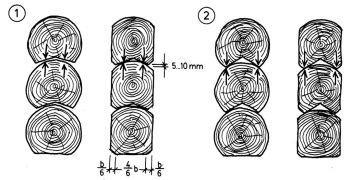
An equal scribe (1) and an overscribed (2) groove for both a Round Log and a Square Log
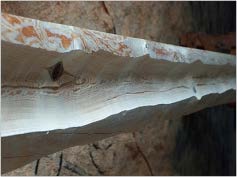
A log with a groove
Corner styles are one of the most important elements of the log house construction. Corners must lock tightly in order to guarantee the impermeability to the elements. Corner styles can be divided into saddle notch corners where the logs protrude from the corners, and dovetail corners in which case the logs do not protrude.
It is much more efficient in the sense of space usage to utilize vertical posts for the interior walls. Vertical corner posts can be used for exterior walls as well, but in this case, they would require flashing. Ajalooliselt on kasutatud palju erinevaid nurgaseotisi. Tänapäeval on kõige levinumad nn Norra tapp, järsknurk ja kalasaba nurk, mille eelis ilmneb kui on soov palksein katta voodriga.
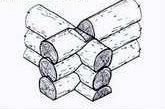
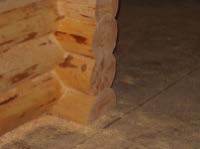
1. Saddle Notch
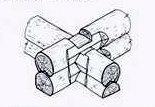
2. H-notch
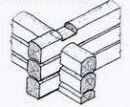
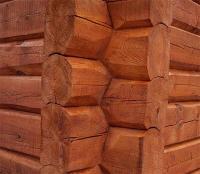
3. Square Notch
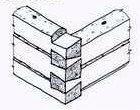
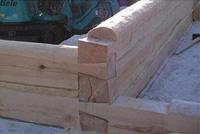
4. Dovetail
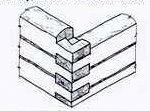
5. Half lap joint
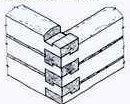
6. Full lap joint